This has been a year of serious editorial for me - massive features and profiles.
I've interviewed Sophie Calle, Goshka Macuga, Thomas Hirschorn, Jeremy Deller, Alex Bag, Janet Cardiff and Georges Miller, Bernadette Corporation, Josephine Meckseper, Rashid Johnson, Thomas Demand, Jim Shaw, Sara VanderBeek, Brendan Fowler, Mariko Mori, Sture Johanesson, Bjarne Melgaard, Santiago Sierra, Thomas Ruff, Genesis P Orridge, and a bunch of younger artists.
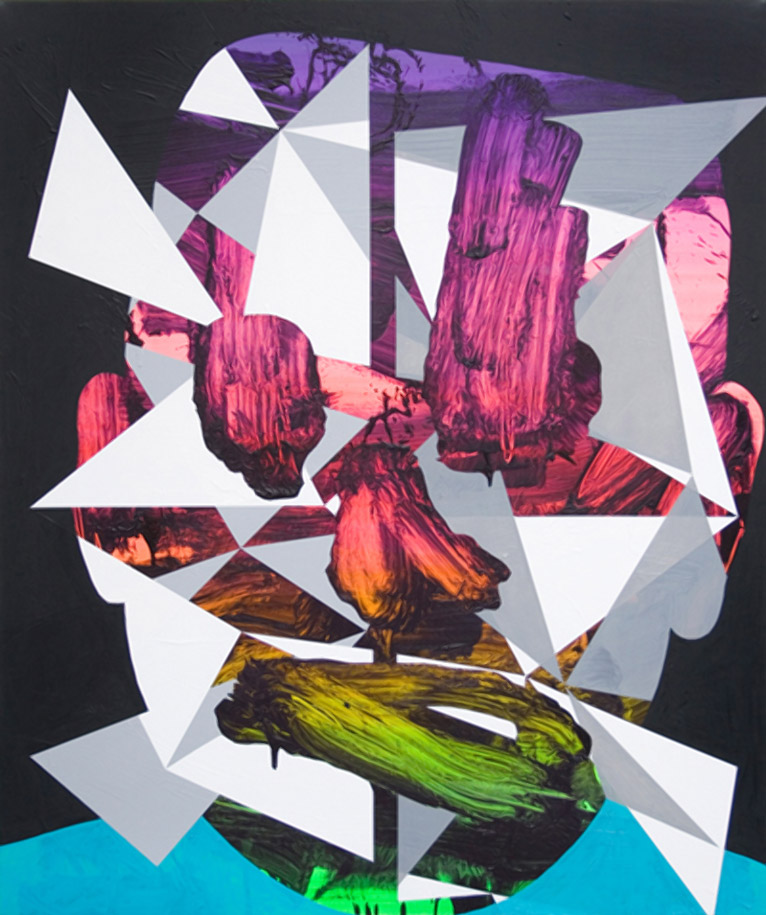
My favourite piece was History Bites/Off-Modernism for Dazed & Confused's New Aesthetic issue this autumn, which they have placed online. (The Chris Dorland image above was one of the works commissioned to illustrate the idea).
Other favourites include a piece on off/online galleries for Its Nice That (which I've pasted below) and a big examination of the contemporary male nude for Sleek.
---
Transcending to Outer Space: curating the real and the virtual
Text Francesca Gavin
Space. It’s a word you can’t escape
in the art world. A much sexier option than the prosaic ‘room’. Space is
high-brow. It implies a location for worship and inspiration, something
otherworldly. It’s a one step way to sound art literate. ‘Not sure about the
work but I loved the space’. ‘Space’ is particularly hot now because of our
relationship with the digital and virtual. In an era defined by the screen, a
new conversation is arising between real and virtual space.
The past few years have seen a generation
of artists exploring our relationship with the virtual. What artist-curator
Marisa Olson coined as ‘post-internet’ artists. The term has developed to not
just define artists who work with technology and internet references, but to
cover a much wider group of artists working in mediums from sculpture to moving
image. Artists with an awareness of the internet but who do not necessarily
make work about or using technology. People like Timur Si-Qin, Marlie Mul, Ed
Atkins, Brenna Murphy, Benedict Drew, Harm van den Dorpel and many more. These
are artists growing up in an environment as the presence of the internet was
cemented. This emerging generation presents a challenge to the future of
contemporary art and its curators. How do you show art when the space that
really counts is a rectangular glowing screen?
Emerging online galleries are
presenting an alternative to the structure of space that institutions, private
galleries and projects space provide. An alternative to physical spaces full
stop. London collective LuckyPDF’s online TV programmes are lo-fi curatorial spaces,
DIY locations where artists perform and exhibit work in a digital wild-west
style. Their intentionally scratchy and raw approach garnered them a lauded
project at 2011’s Frieze Art Fair. Other online galleries follow are more
direct format. Places like the linear tumblr-esque SPAMM in Paris, the long
running blog-like Rhizome in New York or London’s virtual project space
pyramidd.biz. The most successful of these spaces is bubblebyte.org.
The gallery was started by artist Rhys
Coren and curator Attilia Fattori Franchini in January 2011 and has quickly
become the go to space to see artists experimenting with how to show their work
online. Bubblebyte is organized in a very similar model to a conventional
gallery space – a varied programme of changing solo shows and group exhibitions
with online press releases. “We wanted to keep the relationship with a normal
gallery space as much as we could. As well as showing work, Bubblebyte.org is
slowly educating its audience.” Fattori explains. Their interface is
intentionally simple and accessible. Their choice of works themselves have a
much wider appeal in aesthetic and content that the text heavy, geeky net art
of the 1990s. Works such as Douglas Davis’ ‘The World’s First Collaborative
Sentence’ (1994) or Olia Lialina’s narrative, lo-fi monochrome piece ‘My
Boyfriend Came Back From The War’ (1996). Bubblebyte’s choice of works, in
contrast, are often abstract and even beautiful videos, gifs and animations
accessed at the click of a mouse. There is an innate intimacy at viewing the
work on their site. It’s just your focused attention and the screen – something
very different to the physicality that comes from walking through a gallery
space.
The obvious benefit of online spaces
is reaching a massive global audience from Macedonia to South Korea to
Nicargua. Here art can be accessed directly and intimately with out the
restrictions of the cost, space or technical requirements. Online you don’t need
DVDs, cables, amps, projectors, or any of the organizational noise of real
space. “[Real and virtual space] are not interchangeable, they’re just
different and both valuable.” Fattori points out. “The internet replicates
reality. There’s a massive dialogue between physical and digital. It’s what our
lives are about.”
Coren and Fattori are currently
creating a downloadable version of bubblebyte as a template. The aim would be
to create a community of virtual galleries where artists and curators around
the world can show work. “In the art world there’s a culture to be a bit guarded
and not give away ideas. On the internet to have some authorship or ownership
of something, you share it. If you’re the first person to share it, it becomes
yours,” Coren enthuses.
David Horvitz is an artist with a
curatorial edge who has explored ideas of authorship online in a number of
interesting ways. He has used the readymade structures of the internet to
create work. YouTube, Flkr and Wikipedia have all been the locus of his past
projects. “Initially it was never a choice of virtual over
the physical. It was more about using contemporary means of information
dissemination as a means/strategy for my art practice.” Horvitz explains. “YouTube
is how people watch (and contribute) video, so it was the platform to use. A
place that was public and relevant.”
Part of what
makes Horvitz work so compelling is how it occupies the space between real and
virtual space. For his 2011 ‘Public Access project’, Horvitz drove up the Calfironia coast and took
photographs on public beaches. In all the images, which he inserted anonymously
into Wikipedia for anyone to download, Horvitz himself was subtly present. “I
like the idea of the open future of an image online. You don't know where it
goes. You have no control. It leaves it's original context, and continues to
move through time and space. It is an empty sign that holds meaning where ever
it is held down at that moment.”
The digital and the physical are
concurrent in Horvitz’ projects. ‘For A Brief Time Only Project’ was curated
with Mylinh Nguyen. The pair created a 24 image group ‘exhibition’ that was
purchased as photo prints from drugstores and photo shops around the world. When
someone wanted to see the exhibition, they would email Horvitz their address.
He would research the closest drugstore to them, and send the 24 image files
directly to their local photo lab to print up. The viewer would pay for the
photographs and own the local version of the artwork. “Seth Siegelaub was a
model,” Horvitz explains. “his projects with conceptual artists in the
60's/70's, like the Xerox Book. [The project] is also about today, where things
like Youtube, are frameworks that define certain parameters for how information
is accessed. Someone made Youtube, and then others fill it with content,
fitting in their parameters. In a sense, I try to create frameworks in which I
invite artists to put their works in. It's not just about me playing the
curator. I am interested in works that re-shape the same idea in the physical
world. That it isn't necessarily forcing the project into a physical space. It
is just reshaping some of the ideas. It's re-manifestation.”
How to exhibit artwork which
generates online in physical spaces is one of the central issues in presenting
work that has been generated online. “What we are in effect talking
about here is a process of materialization. Transformed into autonomous
'things' that standalone in a gallery, artworks that originate online take on
an entirely new set of criteria,” Paul Pieroni curator of the aptly named SPACE
studios in Hackney. “This transition augments them in a number of ways,
changing their value, meaning and status within the general flux of other
artworks being shown in real space as well as those online. It equates to a
grand repositioning, the complexity of which is no doubt great. One thing for
me that doesn't really change, however, is the content. A video that goes viral
and gets seen by 500,000 people is still the same video when we show it in a
gallery. It's all these other accessory conditions that mutate. The thing
remains the thing.”
One option to circumvent this
tension between online and offline work is to create a piece that is more than
one ‘thing’. Art that comes in variations of form but can still be viewed as a
valid part of a whole. A sculptural cousin to an internet project for example.
It is something artists Oliver Laric and Aleksandra Domanovic have both done
exceptionally well. They are two of the four people behind the cult site
vvork.com, and have incredibly strong conceptual basis to their work. They helped
push the idea of an artwork as versions of an idea. Things may move differently online, get flatter, move faster, get
smaller – but they are still all artworks. Here they present a model where an online image
having as much validity as an object sculpture, as a reproduction, as a book,
as a film installation, as a sound file. How that manifests in their work is
very different – from Domanovic’s video diptych, web archives and techno
records to Laric’s wax sculptures, online videos – both equally as successful.
Academic
Peter Lunenfeld, author of the fascinating ‘The Secret War Between Uploading
and Downloading’, is captivated by works that
explore how real and virtual space can interact. “I'm interested in a key question - how much digital art and this
kind of experience needs to be locative? That you have to be there to
experience it, versus the net.art dream of the 90s which was that this kind of
art was going to be accessible from everywhere.”
Lunenfeld
sites William Gibson’s novel ‘Spook Country’ as providing a model of how to
push the boundaries between the real and the virtual. “’Spook Country’ is about this locative media artist. It's about
making the transitions between the visible and invisible seamless. It's about
walking through space not thinking that there's anything there and then
something that's informatic will appear. It’s one of the 21st
centuries notions that there's a way to make the invisible presence visible -
that you can create things that are completely ephemeral that can be accessed.”
For Lunenfeld, art that uses
augmented reality is a contemporary way to manifest this Gibson-like approach. An
example he suggests is Los Angeles-based Adrian Saxe who embeds QR codes into
ceramics. Here objects looked at as organic and part of an ancient heritage are
transformed to be linked to California’s history of industry, jet engines and the
modern. Another case is artist and designer Didi Dunphy who explores the
relationship between feminism and modernism. Past work have included needlepoint
QR codes that links directly to videos that you can only access by seeing that
piece in the gallery. In both these cases, objects in real space are
re-mystified. “I think people are incredibly interested in a search for the
techno sublime. I think they really want these technologies to reengage with
certain level of magic.” Lunenfeld notes.
Artworks in real space are also
becoming magical but in an all-encompassing, completely immersive way. Work by
installation artists like Christoph Buchel, Justin Lowe and Jonah Freeman, Mike
Nelson, Cardiff and Miller and Thomas Hirschorn (in particular his awesome
takeover of the Swiss Pavillion at 2011’s Venice Biennale) have become
blockbuster attractions. These space-heavy experiences are almost impossible to
document, though Mike Nelson’s book to accompany his New York temporary
building sizes artwork ‘A Psychic Vacuum’ did a very fair attempt to recreate a
sense of the mysterious and labyrinthine. The
atmospheric book shows empty corner, strange details, winding staircases
– recreating a sense of journey through its pages. These
artwork equivalent of a theme park ride,
and just as exhilarating. Art that is so overwhelmingly physical and spatial
that there it takes us out of our selves.
Documentation
of spaces in a wider sense has become a fetish for those interested in art. In
the past few years there has been a massive increase in the spread of
installation images. Quarterly magazine AGMA,
and its online counterpart, has created an entire publication around the
concept of installs. The magazine was created by
three editors, two curators and one art consultant. The idea was to create
“a critical art magazine which looks back to what just happened, slowing a
moment in our life. AGMA brings information but doesn't communicates with words,
rather through images,” editor Francesco Stocchi explains.
The reason why
AGMA works is its complete lack of text. Most
catalogues, reviews and profiles present art images accompanied by an often
descriptive text by a writer. Someone has to see the show after all and try to
record it for a wider audience. AGMA, in contrast, focuses purely on the
visual, creating a pictorial conversations with the viewer and somehow
democratizing the whole process.
AGMA’s images together place the emphasis is
firmly on what the curator is doing. Everyone is looking for some who pushes
how to use space. “Our language for installing artwork is most of the time very
limited to classical parameters of setting things at a height of 150cm with
proportional placement etc. This makes our job exciting by trying to find ways
in which people are working to evolve or break this language or highlight those
who are speaking this language fluently.”
As the medium of art changes rapidly – from
performance to installation to sculpture to digital files – the process of
documenting how space is used is becoming incredibly fluid. Exhibitions are
living things with a short lifespan. What makes exhibitions so important and
vital arguable is their ephemerality. “An exhibition connects ourselves, the
artwork and the space to a specific moment in time which is unrepeatable,” as
Stocchi notes.
As ideas around space and how to use it continue to develop, ideas
around time are increasingly part of how space is used. Turner Prize winner
Simon Starling did it most notably in an exhibition, which opened in December
2010 at Camden Arts Centre. ‘Never The Same River (Possible Futures, Probable Pasts)’ brought
together 50 works from 50 years of the gallery’s history. Each work – from artists
including Francis Bacon, Mike Nelson and Susan Hiller - was placed in the
location they originally were shown in throughout the space’s history – like
layers in time fused into one moment. That sense of layering time perhaps is
only possible in real space.
Curator Rob Tufnell thinks there should be shift in awareness about
ideas of how space is used. Tufnell runs his eponymous gallery in Pimlico and
has worked with spaces as varied as Dundee Contemporary Arts, Turner Contemporary, The
Modern Institute and Stuart Shave Modern Art. “I do think a lot of curators
overlook the way works look in space. It’s difficult to teach that and I don’t
think curating courses do. If you look at old school curators, the people who
curated the Ferdinand Leger at the Tate in the 1970s, or Dawn Ades who has just
come out of retirement to do project for Manifesta. They will always talk about
the relationship between work and how they use the space. And giving works the
space they need. I don’t think people talk about that now – they talk about
names and media. There needs to be some kind of correction.”
That correction does not necessarily mean following the trend for
environmental and installation works. “I think we’ve become so blind to things
around us that those are the things that have become memorable because we have
such a short attention span.” Tufnell notes. “I worked for a long time in
Glasgow where a lot of famous artists - Martin Boyce, David Shrigley, Douglas
Gordon, Jim Lambie - all studied under the Environmental Art course up there
run by David Harding. The mantra of the course up there was ‘the context is
half the work’. I kind of see that but at the same time I’ve seen so much
‘context is half the work’ work that it can be terribly dull.”
Tufnell is equally as tentative about our relationship with the internet
and online spaces (though not notably as a research tool). He sites the VIP art
fair as “the emperor’s new clothes” with its emphasis on the selling highly
commercial aspect of the internet. “We don’t look at art anymore we look at
jpegs. Artists want people to see things in the flesh – and as an agent to
artists I have to try to make that happen.”
Learning how to walk the line between online and offline artwork is something
I’m addressing in an exhibition opening at Jacob’s Island this March.
‘Responsive Eyes’ attempted to look at the tension between how we look at art
and at screens. The group show which includes work by artists Antony Antonellis, Paul B Davis, Thomas Lock, Sara Ludy, Michael Ruiz,
Lucy Stokton, Mark Titchner and Artie Vierkant, was inspired by an iconic Op
Art exhibition called ‘The Responsive Eye’ held at
MOMA in New York in 1965. A very young Brian de Palma, of ‘Scarface’ and ‘Carrie’
fame, made a documentary about the exhibition and it’s opening. De Palma
captures the visiting audience’s reaction to the works, notably in fast edited
comments in the end credits, and in brilliant visuals of people bobbing and
moving in front of works trying to capture the best way to view it. The show
and its response seemed a brilliant metaphor for how we look at screens (and
screen based art) today. Instead of optical illusions and minimalist perceptual
games, today we have a constant flux of movement, sound, information and visual
stimulus online. Pieces in the show range from videos to monitor based gifs to
magic eye posters. The aim is to play around with works that examine ways of
seeing.
In
reality, that process of seeing is related to a sense of enlightenment. Part of
the attraction of visiting art spaces is almost religious. A space for those
searching for enlightenment or thought or meaning or profundity (sometimes with
some entertainment thrown in). “Whenever you find any minoritarian cultural
pursuit, [its creators] are doing it with an ecclesiastical devotion.” Paul Pieroni
observes. “The gallery has developed over a long period of time and changed and
morphed. When you enter into one of those spaces there’s a feeling, almost a
transcendent feeling. You can’t enunciate what that is, but I get it. It’s
sacred. It’s ritualised.”